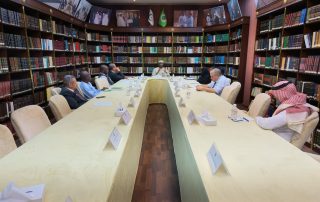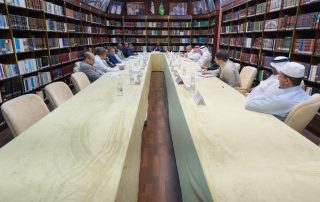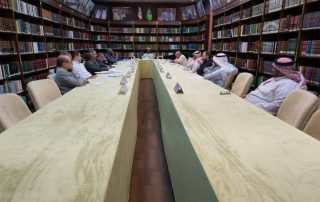
A delegation from the International Islamic Fiqh Academy participated in the 10th Annual International Conference organized by the Egyptian Dar al-Ifta and the General Secretariat for Fatwa Authorities Worldwide. The conference was held in Cairo on the 18th–19th of Safar 1447 AH, corresponding to the 12th–13th of August 2025, under the theme: “Developing the Wise Mufti in the Age of Artificial Intelligence.”
His Eminence Dr. Mohammed Mustafa Ahmed Shuaib, Director of the Department of Research, Studies, and Encyclopedias at the Academy, presented a paper entitled: “Forming the Contemporary Wise Mufti: A Sharia-Based Foundation for the Components and Requirements of Preparation.” In it, he addressed the importance of fatwa and its relationship to ijtihad, introduced the concept of the contemporary wise mufti, and outlined four main requirements for his formation: personal and ethical, scholarly and Sharia-based, contemporary and realistic, and institutional and organizational. His Eminence recommended the need for collaboration among Sharia institutions, Fiqh academies, and universities to prepare and qualify the contemporary mufti academically, educationally, and technically. He also called for the establishment of a specialized postgraduate program in fatwa studies to graduate certified muftis in the future. Additionally, he participated in a workshop entitled: “Anticipating the Future of Fatwa in Light of Expected Developments in Artificial Intelligence,” emphasizing that engaging with artificial intelligence has become a practical necessity, and must be fortified with scholarly and Sharia-based foundations, ensuring it is fed with authentic Islamic knowledge to remain aligned with the teachings of Sharia.
His Eminence Dr. Mohammed Al-Amin Mohammed Silla, Head of the Research and Studies Department at the Academy, participated with a research paper entitled: “The Wise Mufti Facing the Challenges of Artificial Intelligence.” During his presentation, His Eminence defined the key terms of the study, clarified the differences between fatwa and judiciary, and explained the Sharia ruling on the development of artificial intelligence based on the principle of permissibility unless there is evidence of prohibition. He also reviewed the positive aspects of the technology, such as providing services around the clock and assisting in decision-making, alongside its drawbacks, such as its inability to clarify complex inquiries. He explained that reliance on artificial intelligence in fatwa varies depending on the nature of the issues—some matters can benefit from its use, while others, especially those related to customs and changing environments, should not rely solely on artificial intelligence. He concluded his presentation by recommending that the mufti possess scholarly courage to say “I do not know,” affirming that this represents half of knowledge and elevates its bearer, as was the approach of Imam Malik, may Allah be pleased with him.
His Eminence Dr. Abdullah bin Omar Al-Tamimi, Director of the Department of Fatwas, Reviews, and Libraries at the Academy, presented a paper entitled: “The Mufti’s Use of Artificial Intelligence: Rulings, Fields, Regulations, and Applications.” In his paper, he emphasized the importance of integrating artificial intelligence technologies into the work of muftis and fatwa institutions, while adhering to Sharia regulations to ensure the authenticity of fatwas. He explained that these modern technologies facilitate the study of jurisprudential issues and the formulation of fatwas with speed and precision, but they do not replace human ijtihad or the issuance of Sharia rulings under the supervision of scholars. He reviewed the key Sharia-based guidelines for using artificial intelligence in the field of fatwa, warning of the risks of violating them, as this could lead to misguidance or wrongful accusations of disbelief. He outlined the most important practical areas for benefiting from this technology, such as information gathering, issue analysis, and formulation of Sharia rulings. He concluded his paper by recommending the development of muftis’ skills to engage with these modern technologies and called for collaboration in establishing specialized platforms that support the work of fatwa institutions and contribute to the broader and faster dissemination of accurate fatwas.
It is worth noting that the conference aims to discuss the role of the mufti in the modern era and how to qualify and train him to keep pace with technological developments, especially with the spread of artificial intelligence
Read Also
Lastest