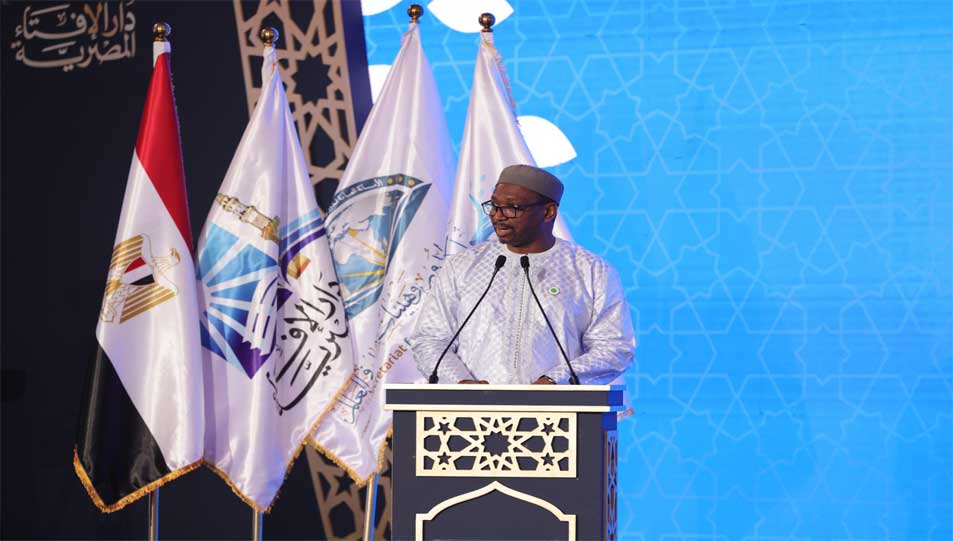
H.E. Prof. Koutoub Moustapha Sano, Secretary General of the Academy, participated in the international conference entitled “Family Challenges Amid Major Transformations,” held in Cairo, Arab Republic of Egypt, on 2-3 September 2026. During the opening session, His Excellency delivered a keynote address highlighting the significance of the family institution and the challenges it faces in an era of rapid and far-reaching change.
At the outset of his speech, His Excellency conveyed the greetings of the Academy’s members and experts to the participants. He emphasised the Academy’s role in clarifying Islamic legal rulings on contemporary issues and underscored the importance of the conference in addressing the challenges confronting families today. He also expressed his sincere gratitude to H.E. President Abdel Fattah El-Sisi, President of the Arab Republic of Egypt, for his generous patronage of the conference, as well as to H.E. Dr. Osama Al-Azhari, Minister of Awqaf, H.E. Dr. Nazir Mohamed Ayyad, Grand Mufti of Egypt, and all those involved in organizing the event. He commended their efforts in preparing the conference, selecting its timely theme, and highlighted Egypt’s rich scholarly and civilizational heritage, as well as the distinguished academic standing of Al-Azhar Al-Sharif. His Excellency affirmed the central role of the family in building individuals, strengthening societies, and ensuring national stability, stating:
“Talking about the family is not merely discussing a private matter, a passing social issue, or an isolated aspect of society. Rather, it is a discussion about the human being: his identity, dignity, and values; and about the nation: its security, cohesion, and progress.”
He further noted that the family is the first institution known to humanity, explaining that:
“Within family, human beings are shaped; from its cohesion, society derives its cohesion; and from its stability, the nation derives its security and stability.”
His Excellency explained that families today face complex, interconnected, and rapidly evolving challenges, including rising rates of divorce, marital disputes and domestic violence, delayed marriage and escalating marriage costs, economic and housing pressures, the weakening of the family’s educational role, and widening generational gaps. He pointed out that:
“A significant part of shaping awareness and values has shifted from parents and teachers to media outlets, digital platforms, influencers, and algorithms.”
He further highlighted the profound impact of cultural, social, economic, digital, and technological transformations, as well as social media, artificial intelligence, and the digital sphere on concepts related to family, identity, education, and human relationships.
His Excellency stressed that these transformations should not be confronted by attempting to halt them, but rather by managing them wisely and responsibly. He stated that:
“Managing these transformations in a conscious and responsible manner is both possible and necessary; indeed, it is a religious duty, a contemporary necessity, and a practical imperative.”
What is required, he explained, is an approach that maximizes opportunities, minimizes risks, and prevents these changes from undermining the fundamental principles upon which the stability of individuals, families, and societies depends. He also emphasized that efforts to address family-related challenges should be guided by the higher objectives of the family in Islam, namely tranquility, affection, and mercy.
Calling for a renewed approach to family issues, His Excellency stated:
“Protecting the family institution today requires us to move from reaction to anticipation and prevention, from treating consequences to addressing causes, from diagnosing problems to creating solutions, and from abstract theorizing to practical policies, programs, and initiatives that can be implemented, measured, and evaluated.”
He emphasized the importance of facilitating marriage, preparing those intending to marry, strengthening the role of parents in upbringing, promoting responsible digital family culture, and developing family counseling, mediation, reconciliation services, and family-supportive public policies.
His Excellency also underscored the need for integration among Islamic, psychological, social, educational, economic, legal, and technological disciplines, explaining that:
“A complex problem cannot be resolved by a single discipline, a single institution, or a single discourse.”
He warned against allowing families to become passive recipients of change rather than active partners in shaping it, cautioning that families should not be transformed:
“from producers of values into mere consumers of them, nor from incubators of awareness into arenas contested by platforms and algorithms.”
Instead, he advocated for:
“a family that is aware of its age, firmly rooted in its values, flexible in its methods, and balanced in its relationships.”
His Excellency further outlined the Academy’s vision regarding family issues, stating:
“At the International Islamic Fiqh Academy, we have always advocated, and will continue to advocate, a transition from the jurisprudence of responding to family crises to the jurisprudence of building the family on sound divine foundations; from a culture of intervention after disintegration to a culture of prevention against breakdown and collapse; and from limited individual ijtihad in family matters to comprehensive institutional collective ijtihad.”
He also stressed the need to move beyond merely identifying challenges toward designing practical initiatives, policies, and programs capable of implementation and evaluation.
In concluding his address, His Excellency drew attention to the suffering of Palestinian families, including killing, displacement, and destruction. He renewed his appeal to:
“our esteemed leaders, respected scholars, and loyal peoples to exert every legitimate effort to support them, strengthen their resilience, and protect their right to life, security, dignity, and survival.”
He expressed hope that the conference would produce practical recommendations and pioneering initiatives that contribute to protecting the family, strengthening its cohesion, and enabling it to fulfill its vital mission of nurturing human development and shaping the future.
Read Also


Lastest