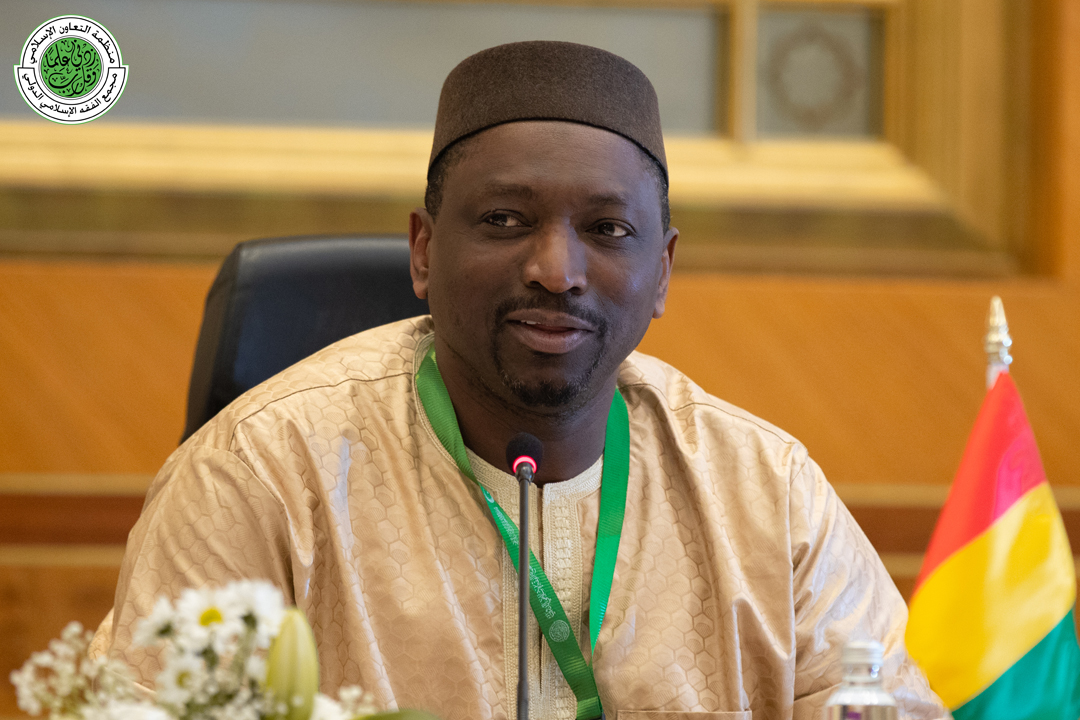
His Excellency Professor Koutoub Moustapha Sano was born on 10 April 1966 in the city of Kankan, Republic of Guinea, West Africa. He received his primary education at Nur al-Islam School and under the tutelage of the scholars of Kankan. He also studied Arabic grammar (nahw), morphology (sarf), Hadith, and Qur’anic exegesis (tafsir) with a number of scholars at the Grand Mosque in Makkah. He obtained the Higher Diploma in French Language Proficiency from the French Ministry of Education (1989). He earned a Bachelor of Education in Fiqh and Usul al-Fiqh with distinction and First-Class Honours from King Saud University, Kingdom of Saudi Arabia (1990), graduating first in his class. He also obtained a Master of Arts in Fiqh and Usul al-Fiqh with distinction from the same university (1993). He received a Postgraduate Diploma in Islamic Banking and Finance from the International Islamic University Malaysia (1998), and a Doctor of Philosophy in Law (Usul al-Fiqh) from the same university with a recommendation for publication of the thesis (1996). He also obtained a Doctorat d’État in Islamic Sciences, specialising in Islamic Finance, with the highest distinction (Excellent) from the Higher Institute of Usul al-Din, University of Zitouna, Republic of Tunisia (2001).
Moreover, His Excellency was appointed member of the Council of the International Islamic Fiqh Academy, representing the Republic of Guinea, in 2001.
His Excellency has held several important academic, administrative, and political positions, including: Professor of Comparative Fiqh, Usul al-Fiqh, Islamic Finance, and Maqasid al-Shariah for sixteen years at the International Islamic University Malaysia; Founding Director of the International Institute for Muslim Unity in Malaysia; and Deputy Rector of the International Islamic University Malaysia for External Relations and Innovations. He also served as Minister of Religious Affairs of the Republic of Guinea, Minister of International Cooperation, Minister for Diplomatic Affairs at the Presidency of the Republic, Diplomatic Adviser to His Excellency the President of the Republic, and was subsequently appointed Secretary General of the International Islamic Fiqh Academy.
Books and Research:
Books:
- Dictionary of Jurists’ Language: Arabic/English/French (co-authored) (Beirut, Dar Al-Nafa’is, 1989).
- Imported Educational Systems in Africa: A Reading of the Civilizational Alternative (Doha, Ummah Book Series, Ministry of Awqaf and Islamic Affairs, 1998).
- The Desired Tools of Ijtihad in Light of Contemporary Reality (Damascus, Dar Al-Fikr, 1998).
- Dictionary of Usul al-Fiqh Terminology (Damascus, Dar Al-Fikr, 1999).
- A Reading of Imam Nursi’s Treatise on Ijtihad (Istanbul, Sozler Publications, 1999).
- Investment: Its Concept, Rulings, and Regulations in Islamic Jurisprudence (Amman, Dar Al-Nafa’is, 2000).
- Savings in Islamic Jurisprudence: Their Rulings and Regulations (Amman, Dar Al-Nafa’is, 2001).
- Encyclopedia of Hajj and Umrah: Arabic/English (Jeddah, Ministry of Hajj, Kingdom of Saudi Arabia, 2003).
- On the Term Terrorism and Its Legal Ruling: A Critical Reading of the Concept and Ruling from a Shariah Perspective (Riyadh, Ministry of Islamic Affairs, Da‘wah and Guidance, Kingdom of Saudi Arabia, 2002).
- An Epistemological Reading of Usuli Thought: Formation and Renewal (Kuwait, Ministry of Awqaf and Islamic Affairs, 2003).
- Rights and Duties of Muslim Women in Light of Principles, Objectives, and Consequences (Kuala Lumpur, Dar Al-Tajdid, 2003).
- The Work of Muslim Women Inside and Outside the Home (Kuala Lumpur, Dar Al-Tajdid, 2003).
- Islamic Economic Thought: Foundations and Prospects (Kuala Lumpur, Dar Al-Tajdid, 2004).
- Debt Trading as Practiced by Malaysian Financial Institutions (Kuala Lumpur, Research Centre, International Islamic University Malaysia, 2004).
- No Denunciation in Matters of Ijtihad (Beirut, Dar Ibn Hazm, 2004).
- Maslahah Mursalah: Its Concept and Contemporary Applications (Beirut, Dar Ibn Hazm, 2004).
- The Endowment of Rights and Benefits: An Epistemological Reading (Kuala Lumpur, Dar Al-Tajdid, 2004).
- Sources of Grammatical Rules in the Balance of Shariah and Reason (Kuala Lumpur, Dar Al-Tajdid, 2004).
- The Desired Collective Ijtihad in Light of Contemporary Reality (Beirut, Dar Al-Nafa’is, 2006).
- How Should We Deal with the Islamic Schools of Thought? Principles and Guidelines (Kuala Lumpur, Dar Al-Tajdid, 2007).
- Education-Oriented Development as a Foundation for Sustainable Development (Doha, Ministry of Awqaf and Islamic Affairs, 2008).
- Ijtihad in Texts: Principles and Guidelines (Riyadh, Maktabat Al-Rushd, 2009).
- Contemporary Fatwa-Making: Its Tools, Ethics, and Regulations (Riyadh, Maktabat Al-Rushd, 2009).
- The Question of Consensus (Ijma‘) in Usuli Thought (Riyadh, Maktabat Al-Rushd, 2009).
- Methodologies of Islamic Sciences and Contemporary Global Changes (Doha, Ummah Book Series, Ministry of Awqaf and Islamic Affairs, Qatar, 2014).
- The Military Council, the Transitional Period, and I: A Minister’s Testimony (Paris, L’Harmattan, 2017).
Research Papers:
- Joint Mudarabah in Contemporary Islamic Financial Institutions.
- Competition Cards.
- The Contract of Muqāwalah (Contracting): Its Nature, Classification, and Forms.
- Modern Corporations: Holding Companies and Their Shariah Rulings.
- Contracts of Adhesion.
- Diminishing Partnership and Its Shariah Regulations.
- Ijarah Sukuk.
- Islamization of Educational Curricula.
- Maslahah Mursalah and Its Contemporary Applications.
- Zakat on Frozen Assets and Similar Funds (An Analytical Perspective).
- Wife’s Maintenance, Salary, and Employment: A Methodological Perspective.
- The New Reading of the Qur’an and Religious Texts (A Methodological Perspective).
- Prevailing Theological, Juristic, Educational, and Islamic Schools: Foundations of Civilizational Adaptation and Positive Engagement with Theological, Juristic, and Educational Heritage.
- Fatwa: Qualifications, Regulations, and Organization in Light of Contemporary Reality.
- Methodology of Reconciling Adherence to Islamic Constants with the Requirements of Citizenship for Muslims Living Outside Muslim Lands (A Methodological Perspective).
- The Creditor’s Disposal of His Debt and the Salam Buyer’s Disposal of His Salam Contract: A Critical Analytical Study.
- Methodology of Addressing Women’s Issues and Regulating Their Educational, Social, Economic, and Political Functions in Light of Shariah Texts.
- The Civilizational Islam Project: Concept, Objectives, and Foundations (A Critical Perspective).
- Human Resource Development in the Muslim World: Education-Oriented Development as a Necessary Approach to Sustainable Human Development.
- Islamophobia: Present and Future Responses.
- Maqasid al-Shariah and Legal Rulings in Understanding and Application: Toward a Maqasid-Based Methodology for Understanding and Applying Texts.
- Rights and Duties of Muslim Women in Light of Contemporary Challenges: Toward a Sound Methodology for Addressing Women’s Issues Theoretically and Practically.
- Endowment of Rights and Benefits in Light of Principles, Objectives, and Consequences.
- The Shariah Perspective on Religious Freedom in Light of Principles, Objectives, and Consequences.
- Women and Public Office in Light of Principles, Objectives, and Consequences.
- Visiting Jerusalem Under Zionist Occupation: A Usuli Perspective.
- Child Marriage in Light of Principles, Objectives, and Consequences: A Critical Reading.
- Female Circumcision from an Islamic Perspective: A Renewed View.
- An Intellectual Response to the Foundations of Extremist Thought: Bases and Horizons.
- Current Accounts: Legal Characterization, Features, and Benefits; A Critical Reading.
- Smart Contracts in Light of Principles, Objectives, and Consequences: An Analytical Perspective.
- Tolerance from the Islamic Perspective: Its Concept, Ruling, and Areas of Application.
- Clarification of the Ruling on the Compulsory Nature of Both Religious and Secular Education for Males and Females in Islam.
- A Shariah-Based Vision for Addressing the Phenomenon of Street Children, Beggars, and Child Laborers.
- The Role of Wills as an Effective Instrument for Poverty Alleviation and Ensuring the Circulation of Wealth in Shariah.
- The Proof of Istishab and Its Applications to Contemporary Issues and New Developments.
- The Impact of Mental Illnesses on Legal Capacity in Shariah.
Read Also


Lastest