
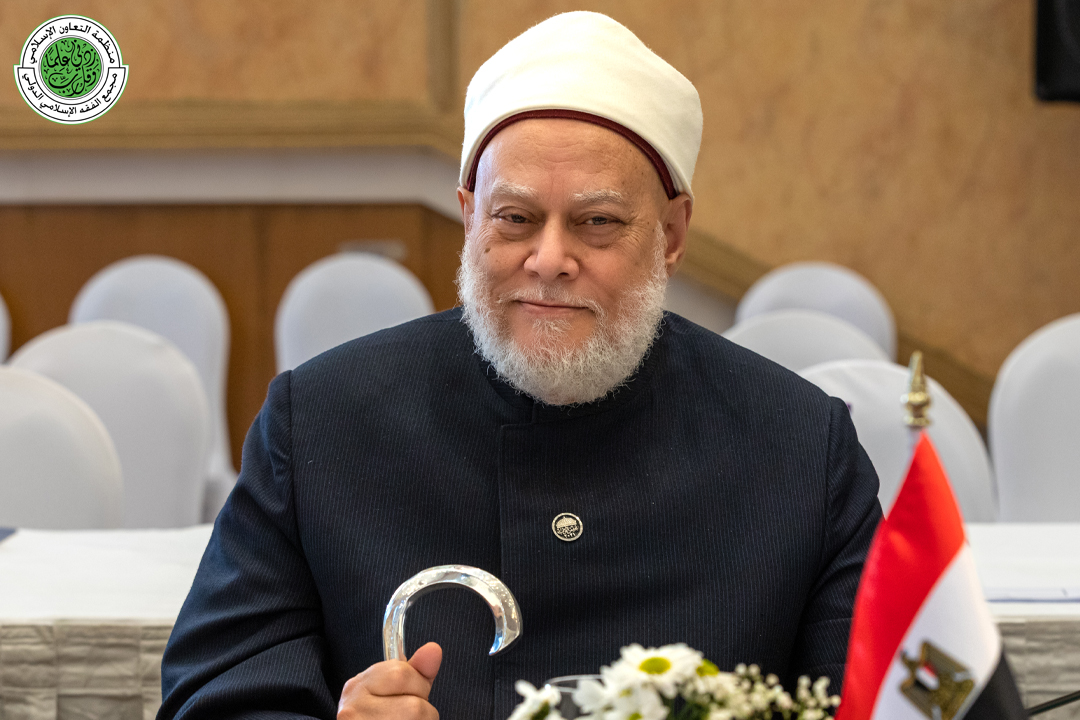
His Eminence Professor Dr. Ali Gomaa Mohamed Abdel Wahab was born on 3 March 1952 in Beni Suef Governorate, Arab Republic of Egypt. He obtained the Higher Degree (Ijazah) from the Faculty of Islamic and Arabic Studies at Al-Azhar University in 1979. He later earned a Master’s degree in Principles of Islamic Jurisprudence (Usul al-Fiqh) from the Faculty of Sharia and Law at the same university in 1985 with distinction, and received his Ph.D. in Usul al-Fiqh from the Faculty of Sharia and Law, Al-Azhar University, in 1988 with First-Class Honors.
His Eminence was appointed as a delegated member of the Council of the International Islamic Fiqh Academy (IIFA), representing the Arab Republic of Egypt in 2004. Throughout his distinguished career, he has held numerous prominent positions, including:
- Grand Mufti of Egypt (2003-2013).
- Professor of Usul al-Fiqh at the Faculty of Islamic and Arabic Studies, Al-Azhar University.
- Chairman of the Board of Trustees of Misr El-Kheir Foundation.
- Associate Supervisor at Harvard University Egypt in the Department of Oriental Studies.
- Associate Supervisor for Middle Eastern Islamic and Arabic Studies at the University of Oxford.
- Chairman of the Jurisprudential Committee affiliated with the Council of Senior Scholars at Al-Azhar.
- Member of the Egyptian House of Representatives since 2021.
- Member of the Council of Senior Scholars at Al-Azhar.
- Full Member of the Egyptian Scientific Academy.
- Member of Al-Azhar’s Fatwa Committee.
- Full Member of the Royal Aal al-Bayt Institute for Islamic Thought in the Hashemite Kingdom of Jordan.
- Member of the Committee for Fiqh Studies at the Supreme Council for Islamic Affairs.
His Eminence has been awarded numerous honors and distinctions, including the Jerusalem Star, the Egyptian Armed Forces Shield, the First-Class Order of Sciences and Arts, and the First-Class Order of Independence of the Hashemite Kingdom of Jordan.
Books and Publications
Among his most notable works are:
- The Effect of the Disappearance of the Subject Matter on Legal Rulings.
- Islam and Equality: Between Reality and Aspiration.
- Fatwa Issuance between Jurisprudence and Reality.
- Imam al-Bukhari and His Sahih.
- Imam al-Shafi‘i and His Juristic School.
- Legal Rulings in the Theory of Usul Scholars.
- Commands and Prohibitions in Usul al-Fiqh.
- Consensus (Ijma‘) According to Usul Scholars.
- Analogical Reasoning (Qiyas) According to Usul Scholars.
- Conflicting Analogies in Usul al-Fiqh.
- The Authority of the Companion’s Opinion in Usul al-Fiqh.
- Mechanisms of Ijtihad.
- The Evidentiary Value of Dreams in Usul al-Fiqh.
- Renewal in the Principles of Islamic Jurisprudence.
- The Issue of Terminology in Usul al-Fiqh with an Application to the Definition of Qiyas.
- Abrogation (Naskh) According to Usul Scholars.
- The Creed of Ahl al-Sunnah wa al-Jama‘ah.
- Usul al-Fiqh and Its Relationship to Islamic Philosophy.
- A Civilizational Juristic Vision for the Hierarchy of the Objectives of Sharia.
- Four Prophetic Models for Coexistence with Others.
- Introduction to the Study of Islamic Schools of Jurisprudence.
- The Craft of Fatwa (from the Islamic Enlightenment Series).
- Encyclopedia of Authenticated Fatwas.
- Collections of fatwas issued during his tenure as Grand Mufti of Egypt.
- Clarification for Troubled Minds.
- Facilitating the Path: Commentary on the Rites of Hajj.
- Hajj and Umrah: Secrets and Rulings.
- Jihad in Islam.
- Religion and Life: Contemporary Fatwas.
- The Muslim Family Fatwas.
- Ramadan Fatwas.
- Modern Fatwas of the Grand Mufti of Egypt.
- Women’s Fatwas.
- Fatwas for Muslim Women.
- Good Words: Contemporary Fatwas.
- Preparing for Ramadan.
- The Ethical Education Program in the Prophetic Sunnah.
- Education and Moral Conduct.
- Steps Toward Abandoning Sins.
- Supplication and Remembrance.
- The Path for Beginners (Commentary on Bidayat al-Salikin).
- The Path to Allah.
- Ramadan Gatherings of the Righteous.
- Revelation: The Noble Qur’an.
- Put Love on Trial.
- The Egyptian Experience (from the Islamic Enlightenment Series).
- Characteristics of the Age: A Reflective Vision.
- Our Master Muhammad, Messenger to the Worlds.
- The Path to Islamic Heritage.
- Women in Islamic Civilization.
- Lectures on Sufi Jurisprudence and the Rulings of Sharia.
- Women between Islam’s Justice and Modern Misconceptions.
- Issues Concerning Women in Islamic Jurisprudence.
- Measures and Weights.
- Who Is Your Prophet? He Is Our Master Muhammad, the Chosen One (peace and blessings be upon him).
- Al-Nibras fi Tafsir al-Qur’an al-Karim.
- The Prophet (peace and blessings be upon him).
- The Imam Said: The Great Principles.
- The Extremists: Their Methodology and a Discussion of Their Major Issues.
- Guidelines for Juristic Renewal.
- Concept Building: An Epistemological Study with Applied Models.
- The Truths of Islam in Response to Doubts and Misconceptions.
- Female Circumcision Is Not an Islamic Rite.
- Islamic Methodology.
- The Niqab Is a Custom, Not an Act of Worship.
- The Fatwas of Imam Muhammad Abduh.
- Al-Amwal by Abu Ja‘far Ahmad ibn Nasr al-Dawudi.
- The Economic Treatises of Ibn Nujaym (Al-Rasa’il al-Zayniyyah in the Hanafi School).
- The Law of Justice and Fairness in Resolving Waqf-Related Issues.
- The General Islamic Encyclopedia.
- The Specialized Qur’anic Encyclopedia.
- The Encyclopedia of Islamic Legislation.
- The Encyclopedia of Prominent Figures in Islamic Thought.
- The Encyclopedia of Islamic Civilization.
- The Encyclopedia of Hadith Sciences.
- Sharia Rulings in Personal Status Matters.
- Comparative Legislation: Applying Civil and Criminal Law According to the Maliki School.
- Comparative Studies between Civil Law and Islamic Legislation.
- Encyclopedia of Financial Transaction Fatwas for Islamic Banks and Financial Institutions.
- Encyclopedia of Ibn Taymiyyah’s Fatwas on Financial Transactions and Wealth Regulations.
- Encyclopedia of Islamic Economics in Banking, Currency, and Financial Markets.
- Human Equality in Islam: Theory and Practice.
- A Sharia-Based Foundation for the Concept of Social Security.
- History of the Science of Usul al-Fiqh.
Research Published in the Journal of the International Islamic Fiqh Academy
- The Environment and Its Preservation from an Islamic Perspective, Journal of the International Islamic Fiqh Academy, Issue Nineteen.
- Dialogue among Followers of the Islamic Schools of Thought: The Experience of Rapprochement between Islamic Madhhabs, Journal of the International Islamic Fiqh Academy, Issue Twenty-One.
- The Ruling on Performing Prayer in a Language Other than Arabic, with or without Excuse, and the Ruling on Following Prayer through Telephone, Radio, and Television Broadcasts, Journal of the International Islamic Fiqh Academy, Issue Twenty-One.
.
Read Also

Lastest