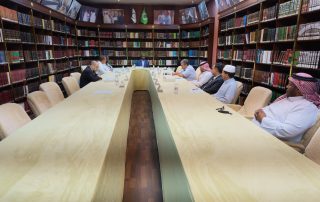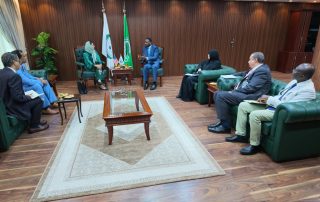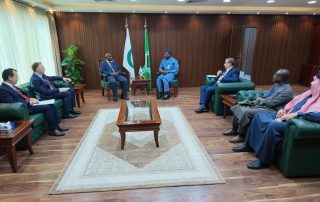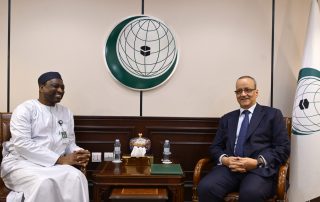
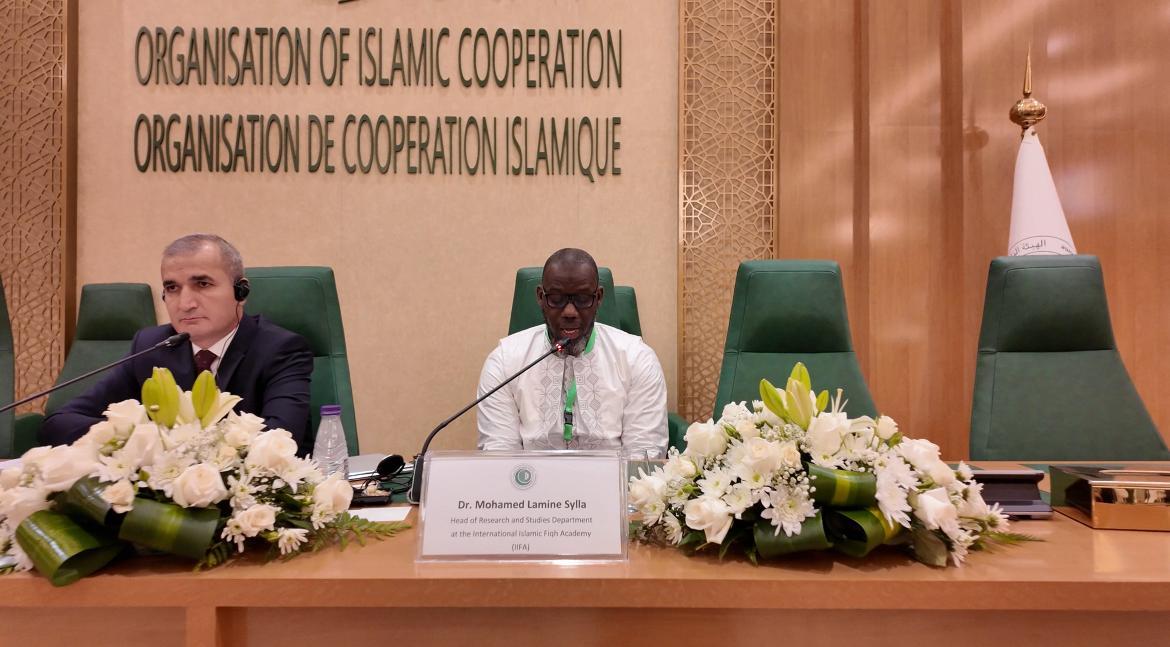
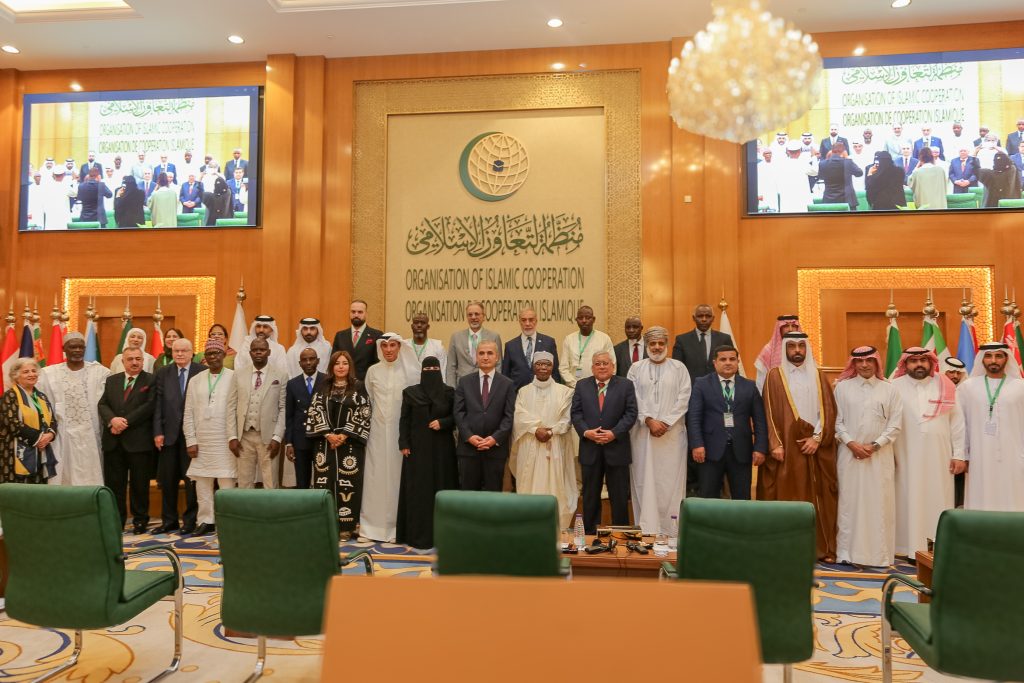
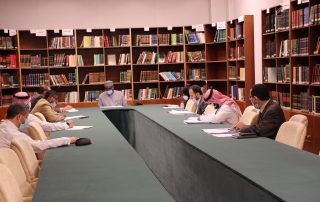
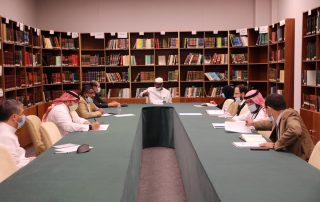
The opening session of the 25th Ordinary Session of the Independent Permanent Human Rights Commission (OIC-IPHRC) commenced on Sunday, 18 Muharam 1447, corresponding to 13 July 2025, at the OIC headquarters in Jeddah. The OIC Secretary General attended the session, H.E. Mr. Hissein Brahim Taha, along with delegates from member states, as well as members and experts from the Commission. The session focused on human rights issues, with one of the main agenda items being the discussion of “The Right to Water from a Human Rights Perspective.”, in which many experts participated and exchanged their views.
Dr. Mohamed El-Amin Sylla, Head of the Research and Studies Division of the Academy, delivered a speech in which he conveyed the greetings of H.E. Prof. Koutoub Sano, Secretary General of the Academy. He emphasized that water is the foundation of life and the source of every living existence, citing the verse: “And We made from water every living thing” (Qur’an), which confirms that water is the origin from which all living beings were created. He also noted that the association of the Throne with Water, as stated in the verse “And His Throne was upon the water”, indicates that water was the beginning of creation. He went on to discuss the importance of water in human life, explaining that it constitutes about 75% of the human body and that no living creature can survive without it.
Dr. Sylla also drew on Prophetic guidance in conserving water and using it responsibly, emphasizing that wastefulness in water use is forbidden in Islam. He cited the hadith of the Prophet (SAW) regarding Sa’d bin Abi Waqqas (RA), when the Prophet (SAW) saw him performing ablution with excess water and asked: “What is this extravagance?” Sa’d replied: “Can there be extravagance in ablution?” The Prophet (SAW) responded: “Yes, even if you are on a flowing river.” He also highlighted the prohibition against urinating in stagnant water and then using it for bathing or ablution, quoting the Hadith: “None of you should urinate in still water that does not flow and then bathe in it.” This emphasizes the importance of maintaining clean water sources, which falls under the scope of public health and safety, and the necessity of keeping water in a pure state suitable for drinking and use.
On the other hand, he presented the Islamic jurisprudential approach to environmental issues related to water. He pointed out that the International Islamic Fiqh Academy issued a jurisprudential resolution in its 19th session (2009) prohibiting the dumping of harmful waste in any place in the world. The resolution obliges producing countries to treat their waste internally without causing environmental harm and prohibits Islamic countries from becoming sites for such waste. It also prohibits any act that disrupts the ecological balance or disregards the interests of future generations. This resolution reflects the contemporary juristic stance rooted in the Islamic legal maxim “No harm and no reciprocating harm,” and demonstrates the Academy’s commitment to protecting water resources and environmental cleanliness from an Islamic perspective.
In conclusion, Dr. Sylla affirmed that protecting water is a fundamental human right and that Islam has expressed this through multiple means: Qur’anic verses that warn against squandering water as a great blessing and categorize it under “Do not waste”, Prophetic guidance that command moderation in its use and preservation of its purity, and practical juristic initiatives that prevent environmental pollution. He expressed his gratitude and appreciation to all those who contributed to the session’s success and hoped that the discussions would lead to practical solutions for providing safe water to all. Dr. Sylla also called for greater international cooperation in the management and protection of water resources.
Read Also
Lastest