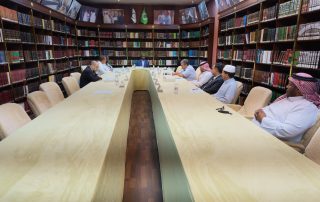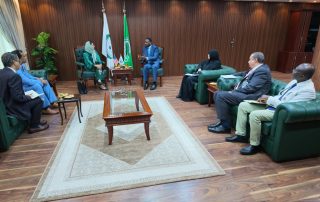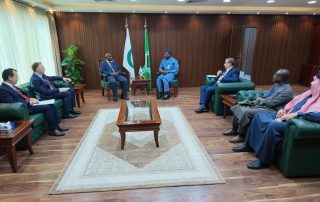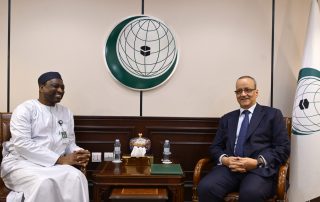
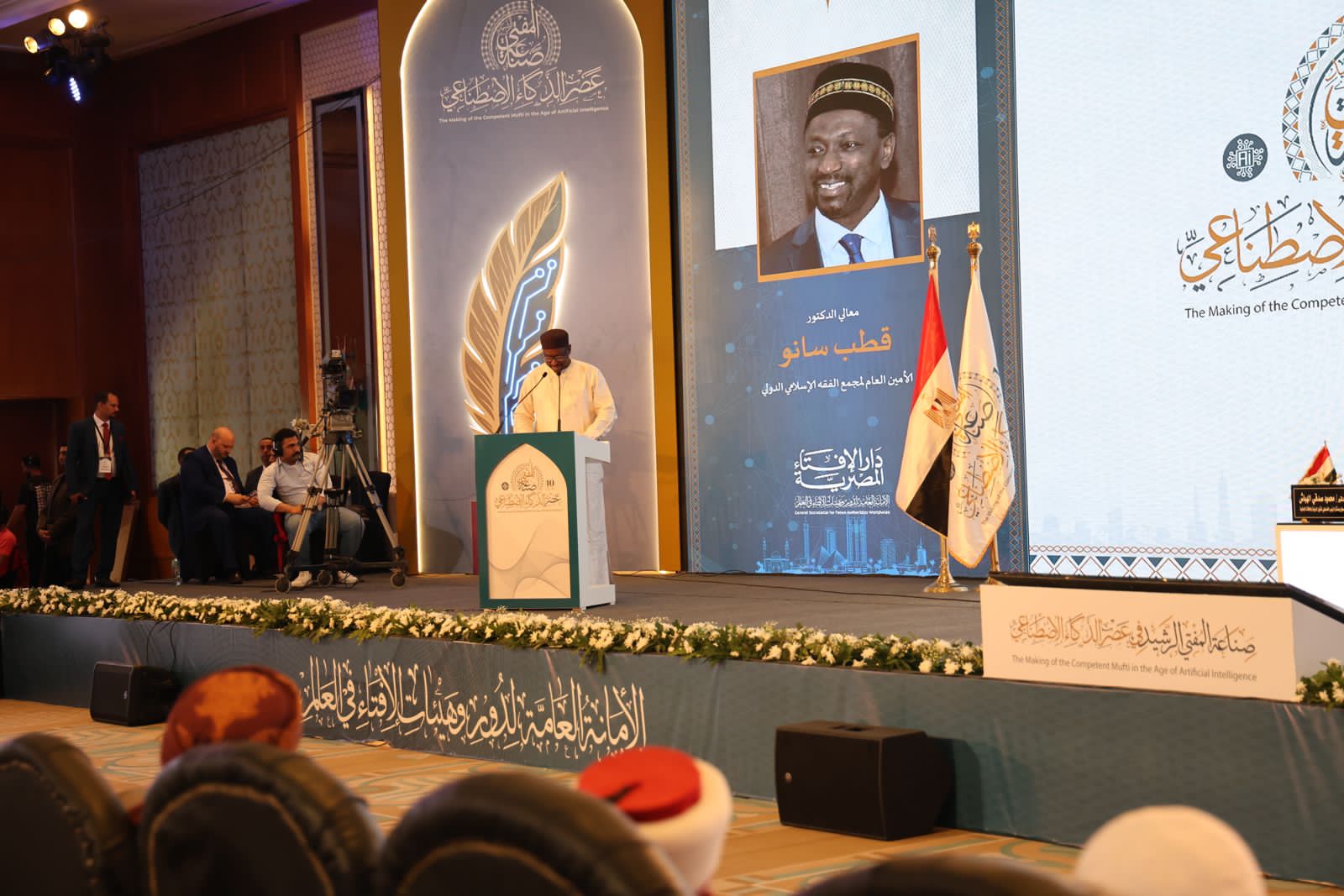
His Excellency Professor Dr. Koutoub Moustapha Sano, Secretary-General of the International Islamic Fiqh Academy, participated in the 10th Annual Conference of Fatwa Authorities and Institutions Worldwide, organized by Egypt’s Dar al-Ifta under the theme “Shaping the Wise Mufti in the Age of Artificial Intelligence,” held on August 12–13, 2025.
His Excellency delivered a speech during the opening session of the conference on Tuesday, the 18th of Safar 1447 AH, corresponding to August 12, 2025. He began by expressing deep gratitude and appreciation to Egypt—its leadership and people—for the warm welcome and generous hospitality. He congratulated the General Secretariat of Fatwa Authorities on the tenth anniversary of its founding. He praised its efforts in strengthening cooperation among fatwa institutions and promoting the values of moderation and balance.
He also commended the notable achievements of Professor Dr. Nazir Muhammad ‘Ayyad and his predecessor Professor Dr. Shawki Allam in establishing a global institutional framework for fatwa work.
He noted that the Academy’s participation in this conference serves to affirm and confirm its status “as the supreme collective jurisprudential authority for the member states of the Organization of Islamic Cooperation, taking pride in its participation in this conference in fulfilment of what God has entrusted to scholars: ‘You must make it clear to the people and not conceal it’, and in realization of the trust placed in it by the leaders of Islamic countries and Muslim communities to clarify God’s rulings on emerging and critical issues that carry great danger and deep impact, where individual fatwas are prohibited, to safeguard people’s beliefs, protect unity, and promote the values of moderation, balance, and tolerance.”
His Excellency then spoke about the key characteristics that must be present in a mufti to be rightly described as a “wise mufti,” saying:
“This great scholarly conference convenes at one of the most critical hours, in one of the most challenging moments, indeed in a time when the Ummah is in utmost need of the wise mufti—he who upholds the beacon of truth, builds fortresses of safety, sows hope, tranquillity, and peace in hearts, transforms challenges into opportunities, turns pressures into achievements, adapts the changing reality to respond to the fixed teachings of revelation, and speaks on behalf of the Lord of creation with confidence and steadfastness, undeterred by threats, and unshaken by blame.
He defends the noble religion against distortions by extremists, misinterpretations by the ignorant, and fabrications by impostors. He clings to the unchanging principles without compromise, reflects deeply on changing circumstances without rigidity. His fatwa builds rather than destroys, unites rather than divides, develops rather than devastates, facilitates rather than complicates, encourages rather than alienates.
He is balanced in thought and behavior, dries up the sources of extremism, demolishes the strongholds of fanaticism, and confronts the storms of discord with strength, resolve, and determination. He repels the winds of misguidance, deception, and atheism, skillfully balancing benefits and harms, considering consequences and contexts. Wisdom never escapes his sight, and his heart remains firmly guided.
His ultimate goal and highest concern in issuing fatwas and delivering religious guidance is to lead people to righteousness, unify the community, protect society, and realize the sovereignty of religion over reality—so that man becomes a servant of God by choice, just as he is by necessity.”
He added:
“This mufti is open to the modern age, undaunted by the crashing waves of artificial intelligence. Rather, he transforms them into tools that serve religion, the Ummah, and humanity. He is not intimidated by the complexities and powers of modern digital technology; instead, he understands and utilizes them—for compiling, verifying, analyzing, and classifying texts, comparing opinions and perspectives, and refining ideas—turning them into a harnessed blessing, not a raging trial.”
Regarding the formation of the wise mufti in this era, His Excellency affirmed that this endeavor “has become a religious obligation, a contemporary necessity, and a timely interest—strengthening intellectual security, which is indispensable; preserving the objectives of Islamic law, which are non-negotiable; and protecting nations, peoples, and societies from fragmentation and decline.
Indeed, forming such a mufti depends on our voluntary review of our religious, social, and human curricula, aiming to elevate them to meet escalating challenges, rapid developments, and continuous changes. The goal is to produce enlightened minds, pure hearts, and truthful tongues that defend the Ummah from harmful doubts, shield societies from destruction, and protect individuals from moral ruin.
This can only be achieved by renewing content and modernizing methods to align with the times—combining deep knowledge of divine revelation with mastery of human and civilizational sciences, and blending strong reasoning skills with an understanding of the tools and media offered by the age.”
In conclusion, His Excellency conveyed the Organization of Islamic Cooperation’s appeal to nations, peoples, and the international community to cooperate and show solidarity in urgently ending the tragedy faced by the Palestinian people—especially the wounded Gaza, which suffers under a brutal siege, systematic starvation, and savage aggression by an extremist Zionist occupation whose heinous crimes are condemned by all religions and laws. He added: Supporting this wounded and oppressed people is not a choice, but a sacred duty in all religions and laws. Feeding its hungry is not an act of charity, but a fundamental humanitarian obligation recognized by all customs and traditions. Defending its cause is neither a favor nor a privilege, but a moral responsibility upon everyone who possesses a word, a stance, or a position.”
His Excellency also praised the blessed and tireless efforts exerted by the Kingdom of Saudi Arabia through its Islamic ministerial committee, as well as the wise mediation efforts undertaken by the Arab Republic of Egypt and the State of Qatar, praying that they be crowned with success and prosperity:
“So that the occupation may be defeated, the blockade lifted, smiles return to the lips of Palestine’s children, its noble women reclaim their dignity, serenity flows into the faces of its elders, and hope and safety revive in the hearts of its youth. And Allah is predominant over His affair, but most of the people do not know.”
Read Also
Lastest