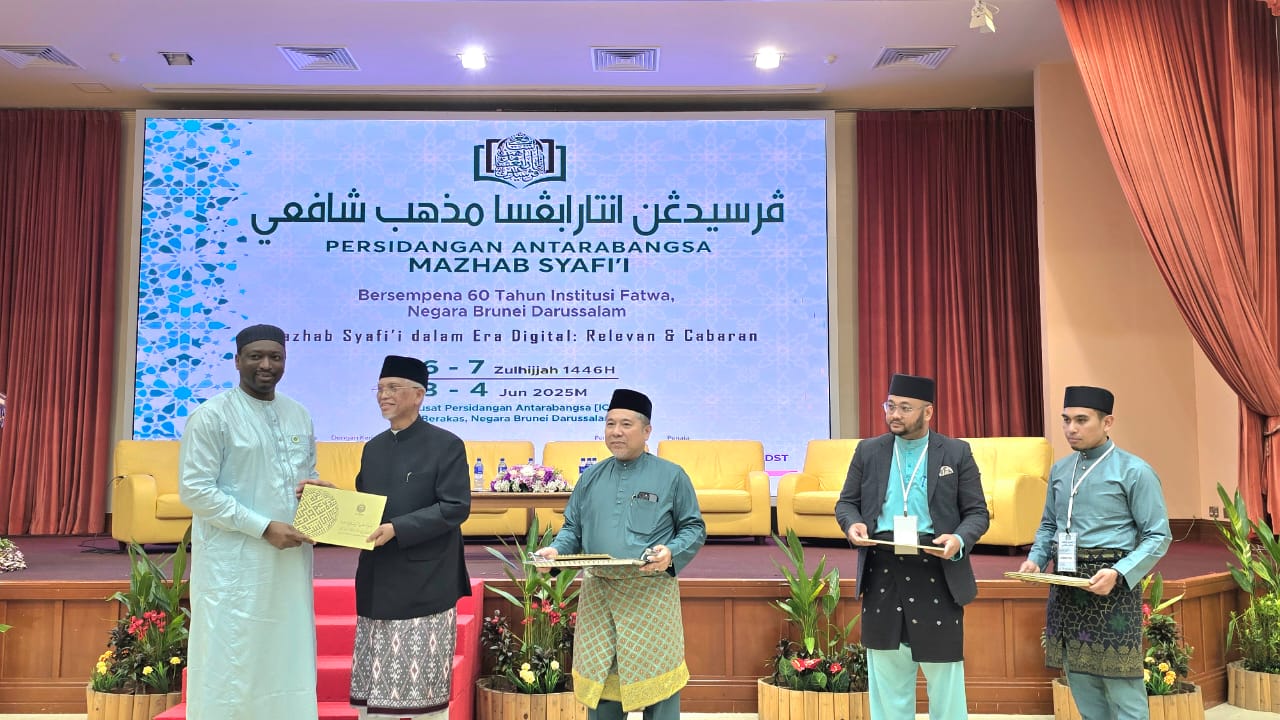
His Excellency Prof. Dr. Koutoub Moustapha Sano, Secretary-General of the International Islamic Fiqh Academy, delivered the keynote address on Tuesday, 7 Dhul-Hijjah 1446 AH corresponding to June 3, 2025, at the International Scientific Conference titled “The Shafi‘i School in the Age of Digitalization”, organized by Sultan Sharif Ali Islamic University (UNISSA) in Brunei Darussalam, attended by a distinguished group of scholars and researchers.
At the beginning of his speech, His Excellency expressed profound gratitude to the government and people of Brunei for their warm welcome and generous hospitality. He praised the support of His Majesty Sultan Haji Hassanal Bolkiah for knowledge, scholars, religious moderation, and academic excellence. He commended the organizers for choosing a highly relevant and timely topic.
He then reviewed the impact of digitalization on education and knowledge transmission, explaining that access to Islamic scholarly heritage has become, by the grace of God and digital technologies, available to everyone at the click of a button—after having been confined to libraries and manuscripts. He emphasized that this transformation offers unprecedented opportunities for preserving and disseminating heritage, expanding its reach, and engaging younger generations through multilingual interactive platforms, as well as enhancing comparative research between schools of thought.
Based on these developments, His Excellency stressed that digitalization has become an inevitable reality, bringing vast opportunities and significant challenges to the Shafi‘i school in particular and Islamic jurisprudence in general. He called for wise and disciplined engagement with digitalization so that it serves Islamic knowledge rather than distorting or weakening it.
He also highlighted the flexibility and openness of Islamic jurisprudence in general and the Shafi‘i school in particular, citing Imam al-Shafi‘i’s well-known “old” opinions from Iraq and “new” ones from Egypt as evidence of the school’s adaptability to different environments, times, and circumstances. He argued that using digitalization to serve the school aligns with this flexible methodology that embraces and engages with reality consciously.
On the other hand, His Excellency warned of key challenges posed by digitalization, including the lack of verification of published content, the risk of oversimplifying complex jurisprudential issues, persistent language barriers, and the potential weakening of the scholarly and spiritual bond between students and teachers due to excessive reliance on digital platforms. He reminded the audience of Imam al-Shafi‘i’s famous poem:
You will not attain knowledge except through six things: intelligence, eagerness, effort, sustenance, companionship of a teacher, and enduring a long period.
In this context, His Excellency urged universities—especially Islamic ones—to introduce a dedicated course that familiarizes students with digital platforms, applications, and libraries, and trains them to use these tools effectively for understanding meanings, analyzing texts, studying fatwas, comparing opinions, authenticating hadiths, and other methods that save time and effort.
He clarified that answering the conference’s central question—Is digitalization a friend or foe to the Shafi‘i school?—depends on how it is used. If employed with awareness and scholarly guidelines, it becomes a friend that enriches knowledge dissemination and preserves authenticity. If guidelines are neglected, it turns into a foe that spreads half-truths and undermines sound methodology.
Finally, His Excellency concluded his speech by calling for strategic frameworks to ensure the quality of digital content, training scholars and students in technological skills, translating and simplifying classical works responsibly, and creating platforms that combine scholarly authenticity with modern tools. He affirmed that digitalization is not a choice but a reality, and what is needed is to embrace it wisely, inspired by the principles of the Shafi‘i school and the spirit of renewal, so that the school remains vibrant and impactful in the digital age.
Read Also
Lastest