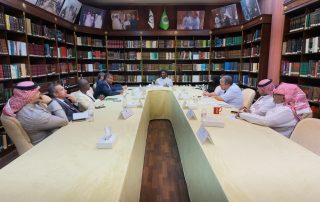

His Excellency Professor Dr Koutoub Moustapha Sano, Secretary-General of the Academy, chaired the fourth scientific session of the First Jurists Forum organised by the Muslim World League in Kuala Lumpur, Malaysia, on Saturday, 3 Rabi‘ al-Awwal 1447 AH, corresponding to 26 August 2025 CE. The session was titled:
“Employing Auxiliary Sciences and Modern Technologies in Jurisprudential Study.”
At the beginning of the session, His Excellency expressed his deep gratitude and appreciation to the organising bodies and all participating scholars and researchers. He emphasised that renewing the mechanisms of jurisprudential reasoning is an urgent necessity to keep pace with the profound transformations occurring globally across scientific, technological, and intellectual domains. He explained that auxiliary sciences—especially the humanities such as psychology, sociology, media studies, political science, economics, and law, along with artificial intelligence applications—are no longer merely supportive disciplines, but have become essential components in deriving legal rulings, understanding the objectives of Islamic law, and applying them to emerging issues and contemporary challenges.
His Excellency stressed that harnessing modern technologies—particularly artificial intelligence, digital modeling, and virtual simulations of real-world scenarios—can significantly enhance the efficiency of jurisprudential research, improve the quality of contemporary fatwas, and strengthen their ability to serve public interests and prevent harm.
He also called for institutionalizing the integration between revealed knowledge and human sciences through the adoption of a dual-specialization system. This system would require students of Islamic sciences to choose a minor in one of the humanities, and vice versa, requiring humanities students to select a minor in one of the Islamic disciplines. He praised the International Islamic University Malaysia for its implementation of this model, which offers broader opportunities for graduates and promotes values of moderation, tolerance, openness, and reduces manifestations of extremism and fanaticism in addressing contemporary issues and changes.
The session concluded with a series of rich scholarly contributions and discussions involving esteemed scholars and researchers. These exchanges underscored the importance of incorporating modern sciences into the curricula for training jurists and developing jurisprudential research tools and resources in a way that fulfills the higher objectives of Islamic law.
Read Also

Lastest