
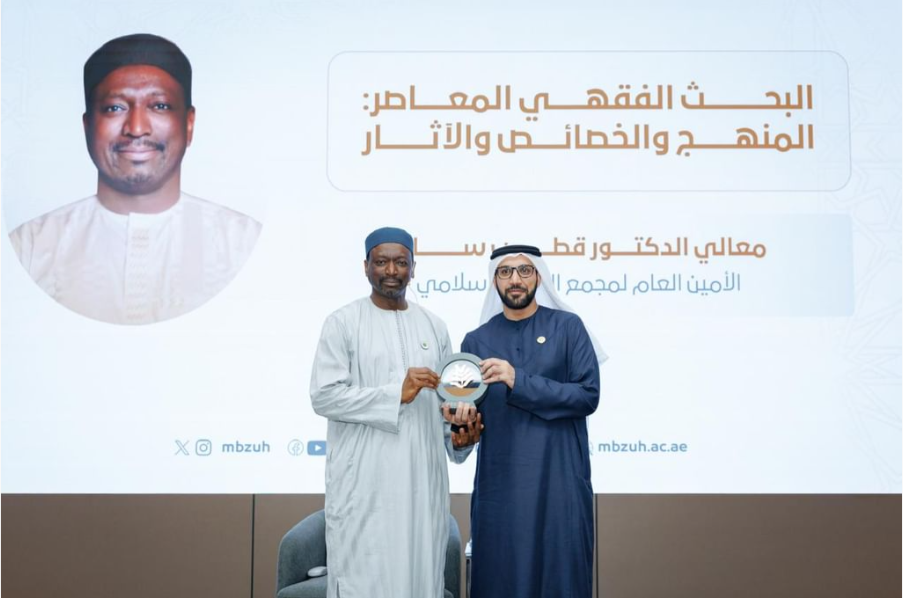
At the kind invitation of Mohamed Bin Zayed University for Humanities in Abu Dhabi, His Excellency Professor Dr. Koutoub MoustaphaSano, Secretary-General of the Academy, delivered on Tuesday, 20 Jumada al-Ula 1447 AH, corresponding to November 11, 2025, a scholarly lecture entitled “Contemporary Jurisprudential Research: Methodology, Characteristics, Impacts, and Prospects” at the university’s headquarters.
The lecture was attended by His Excellency Dr Khalifa bin Mubarak Al-Dhaheri, University President; His Excellency Professor Dr Ridwan Al-Sayyid, Dean of the Graduate School; His Excellency Dr Mohammed Al-Bashari, Secretary-General of the World Council of Muslim Communities, along with a distinguished group of faculty members and students.
His Excellency began his address by expressing deep gratitude to the university leadership for their kind invitation, warm reception, and generous hospitality. He praised the university’s remarkable achievements in a short period since its establishment, affirming that Mohamed Bin Zayed University for Humanities has become a prestigious academic beacon that combines methodological authenticity, cultural depth, contemporary awareness, and future vision. He emphasised its growing role in advancing rigorous scientific research and strengthening the Islamic civilizational identity—faithful to its religion, loyal to its homeland and leadership, and committed to moderation, balance, and tolerance.
He then offered a historical definition of the term fiqh in Islam, noting that it originally encompassed the meanings of Islam, faith, and excellence (ihsan) as mentioned in Prophetic traditions, before later becoming specialised to mean knowledge of practical legal rulings. He explained that this specialisation emerged at the end of the first Islamic century, when the need arose to clarify terminology and distinguish between different sciences.
Moving to the topic of jurisprudential research methodologies, His Excellency explained that they intersect across three interrelated paths:
• The textual-traditional method (naql athari),
• The rational-analogical method (‘aqli qiyasi),
• The reconciliatory method that combines text and reason.
He reviewed the major schools of jurisprudence and their characteristics: the Hanafi school distinguished by rationality and analogy; the Maliki school by realism and reliance on the practice of the people of Madinah; Imam al-Shafi‘i’s attempt to combine both approaches; the Hanbalis’ wide reliance on authentic Prophetic texts; the Ja‘fari (Shi‘i) school’s selectivity requiring narrators from the Prophet’s household; and the Ibadi school’s use of reason when traditions were scarce. He concluded that the diversity and interaction of these schools shaped the methodology of Islamic jurisprudence.
His Excellency also highlighted the characteristics of jurisprudential knowledge, noting its comparative construction across Islamic sources, its focus on practical rulings guided by objectives (maqasid), and its distinction from other Islamic sciences. He praised jurisprudential research as a religious science firmly rooted in its foundations (Qur’an and authentic Sunnah), while simultaneously relying on the higher objectives of Sharia and universal values such as justice and mercy. These features, he stressed, gave jurisprudence a civilizational role in the history of the Muslim community.
On the impacts of jurisprudential research on legislation and civilization-building, His Excellency explained that it has been a foundational force throughout Islamic history—entrenching justice and mercy in judiciary and fatwa, establishing comprehensive legislative systems, and developing modern regulatory mechanisms such as Islamic endowments and interest-free banking. He cited examples of contemporary applications, such as the Maliki school’s contributions to judicial fairness and the Hanafi school’s use of analogy to provide flexible solutions to emerging issues.
He then addressed the prospects of jurisprudential research in light of digital transformations and artificial intelligence, stressing that digitization opens vast opportunities for scholars. He emphasized the importance of employing modern digital tools and AI in jurisprudence, such as electronically analyzing and classifying hadiths within minutes instead of weeks. He described these technologies as blessings to be harnessed for religion, while cautioning that they must not replace human scholarly effort. He underscored the need to preserve Sharia principles and values when using them, citing examples of scholars who verified hadith authenticity using modern databases while integrating results with Sharia understanding.
His Excellency also spoke about the importance of linking jurisprudence with the humanities and social sciences to understand the human reality in which texts are applied. He stressed that contemporary jurists must be familiar with social and cultural sciences to grasp modern human contexts, enabling them to issue rulings and concepts that respond to current needs. He called for encouraging dual specialization (jurisprudence and humanities) and equipping Islamic studies students with foundational knowledge in the humanities to deepen their understanding of human reality.
In the framework of preserving and renewing jurisprudential research wisely and consciously, without compromising fundamentals or clinging rigidly to heritage, His Excellency said:
“Our responsibility today as scholars, researchers, and academic institutions is to preserve jurisprudential research by renewing it consciously—without neglecting the fundamentals or freezing on heritage, but striving in light of objectives and guided by the texts, to respond to the challenges of the digital age and beyond, so that Islamic jurisprudence remains a guiding light, a just balance, and a mercy for all humanity.”
He expressed confidence in Mohamed Bin Zayed University for Humanities, with its enlightened leadership and vision, to lead this desired methodological transformation and graduate a generation of creative jurists who combine authenticity and modernity, effort and innovation, serving their religion, homeland, and humanity.
At the conclusion of the lecture, His Excellency praised the pioneering role of Mohamed Bin Zayed University for Humanities as a leading model that combines methodological authenticity, cultural depth, and contemporary awareness. He noted that it has quickly become a prestigious academic beacon concerned with both humanities and jurisprudence. He affirmed that the lecture achieved its goal of highlighting the importance of contemporary jurisprudential research and encouraging its development to serve religion, homeland, and humanity with confidence and clarity.
The lecture witnessed positive interaction from the audience, who commended His Excellency’s scholarly presentation. Dr. Khalifa bin Mubarak Al-Dhaheri, University President, presented His Excellency with a commemorative shield in recognition of his scientific contributions and efforts in serving Islamic jurisprudence and humanity.
Read Also

Lastest